This is the Spine of the Webgold Master GTM. It is the canonical doctrine document. Every other artefact in the Master GTM — the Phase Architecture, the Channel Harmonisation Matrix, the Harmony Calendar, the Gate Register and Tempo Protocol, the Alignment Filter, the Reef Team Briefing — inherits from what is written here. No content appears in any of those derivatives that is not first ratified here.
The Spine is meant to be read once carefully and referenced often. It is not a deck. It is not a one-pager. It is the document that allows every motion at Webgold — content, channel, sales, event, hire, pricing decision — to be tested against a coherent set of commitments. When a question arises about what Webgold should or should not do, the answer is in here. If the answer is not in here, the answer is to bring it to Stephan and Gem and update the Spine before acting.
Sections 1–4 are the foundational doctrine — the Reef premise (§1), what we sell (§2), the white-space claim (§3), the four-position commitment (§4). Sections 5–7 are operational doctrine — demand displacement (§5), content portfolio mix (§6), channel hierarchy (§7). Sections 8–11 are systems doctrine — authorship (§8), proof (§9), refusals (§10), economics (§11). Cross-references close the document.
v1.0 ships with §8 (Authorship Architecture) as a structural placeholder. v1.1 cuts on Stephan De Roche's Founder Positioning Brief delivery (~Friday 8 May 2026) at which point the founder voice is operationalised. Until then, no founder-voice content ships from Webgold without explicit Stephan ratification.
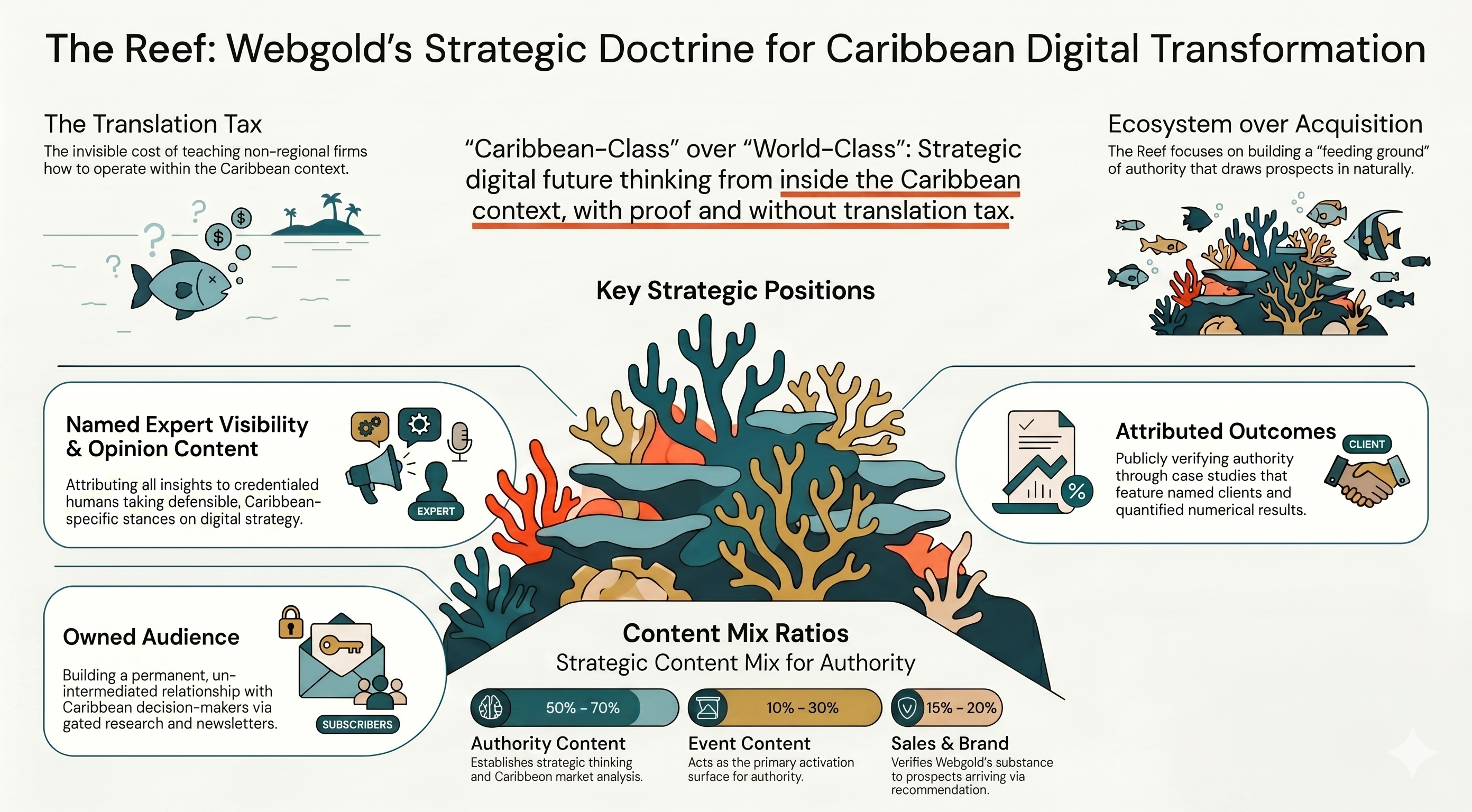
The Reef premise rests on a single observation: the white space we have identified is empty for a reason. It is not empty because no one knows about it. It is empty because the prospects who would value it have not yet been taught to look for it. They are still fishing the traditional grounds — the global firms, the marketing-vendor agencies, the offshore consultancies — because that is where the food is. To bring those prospects to clear water, we have to first build a feeding ground worth coming to. The Reef is that feeding ground. It is ecosystem-construction before client-acquisition. It is the deliberate choice to spend the first phase of this strategy not chasing prospects but assembling the conditions that will draw them.
The metaphor matters because it changes our orientation. A traditional go-to-market works on the assumption that the audience exists, knows it has a problem, and is searching for a provider. Most of marketing strategy is about making your provider the most visible, the most credible, or the most differentiated within that existing search. The Reef makes a different assumption. Our audience exists, but it has not yet named the problem we solve. It is investing in marketing tools, in agencies, in piecemeal digital fixes — and accepting the translation tax that comes with each one — because no alternative has been visibly modelled to it. Our work is not to compete in the existing search. Our work is to change what the audience is searching for.
That is what the Reef does. We build educational signals that reframe the problem. We build authority signals that name us as the people thinking clearly about it. We build proof signals that show what working with us actually produces. We build community signals that demonstrate the ecosystem already exists and is healthy. Each of these is a structure on the Reef. Together they create the environment in which the right prospects arrive — not because we caught their attention but because the water is finally worth swimming to.
A five-year construction project
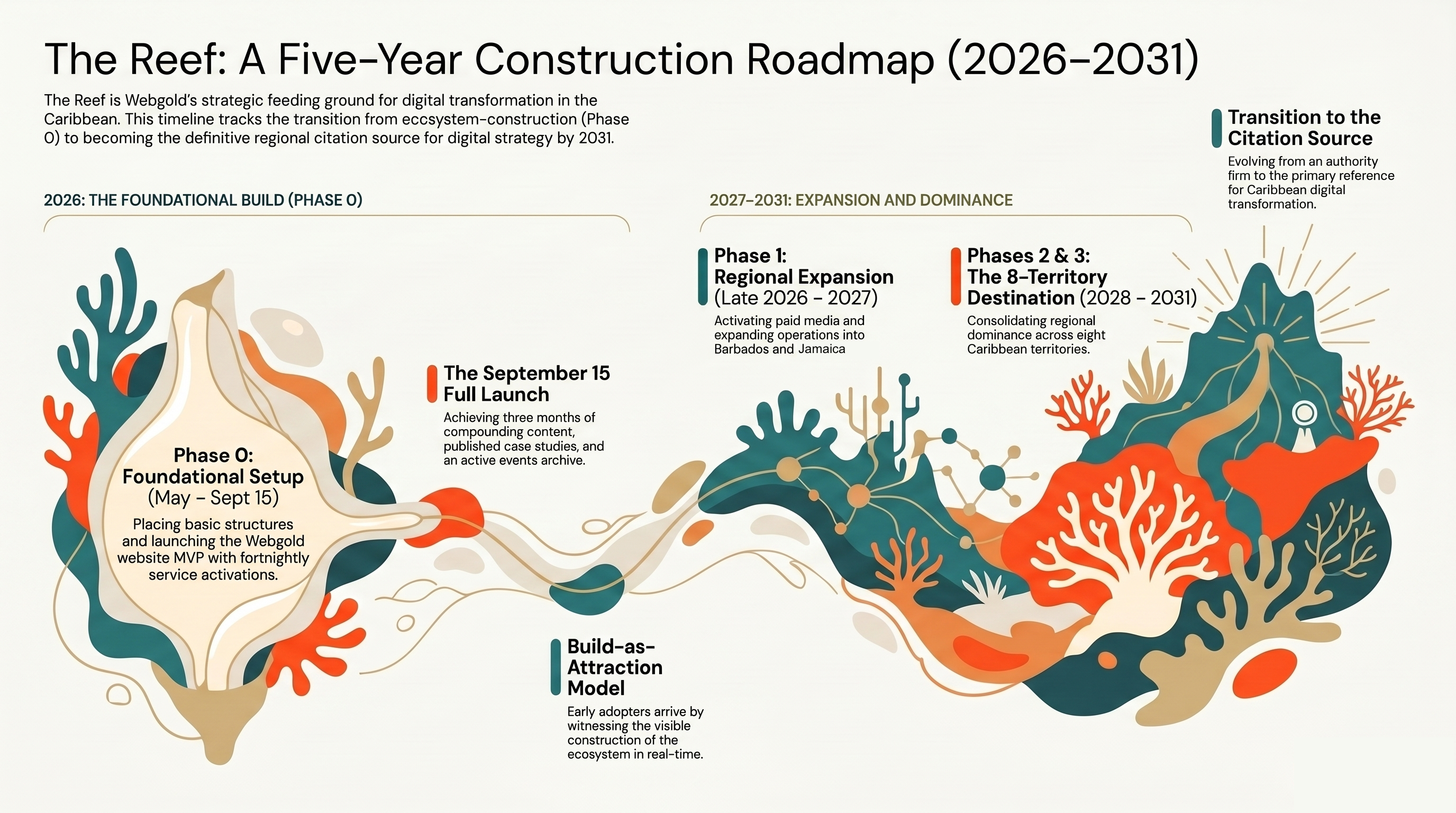
The Reef is built over five years (2026 through 2031). What this Spine governs is Phase 0 of that construction — the foundational period from May 2026 through September 15 2026 — during which the basic structures are placed. The Webgold website (WG-25) ships in MVP form on April 30, then activates one service line per fortnight for seven sprints. The Reef Phase 0 motion runs alongside that build: low-volume, high-authority, named-author, T&T-specific, with proof harvesting beginning at Sprint 1, gated research assets dropping at Sprint 2 and Sprint 5, and a live events programme running concurrent to all of it — multiple workshops, executive roundtables, and the CommUnity 2026 sponsorship moment on July 2 (PRos & COMMS conference). By the September 15 full launch, the Reef has three months of content compounding, four published case studies, two gated audience-building assets, an active newsletter cadence, and an events archive in motion. This is not the Reef finished. This is the Reef inhabited — the moment at which the structure is healthy enough, and visible enough, that prospects arrive through invitation rather than chase, through curiosity rather than cold outreach, through choice rather than pressure.
What the Reef commits us to
The Reef commits us to a specific operating principle: we do not optimise for the current audience's search behaviour. We optimise for the audience we intend to create. Every motion we author on the Reef is calibrated to that future audience — the one that has begun to recognise the difference between buying digital tools and architecting digital strategy, between hiring a marketing-services vendor and engaging a clear-thinking partner, between paying the translation tax and being understood without it. The Filter — operationalised at Phase 6 of the cascade — is the gate that polices this commitment week by week. Anything that reverts us to optimising for the current audience is rejected.
This commitment is harder to hold than it sounds. The pressure to chase short-term lead generation is constant. The temptation to ship content that would perform on the current audience's search behaviour is constant. The instinct to follow competitor tactics is constant. The Reef commits us to refusing those pressures during Phase 0 because the alternative is to do what every other firm in the audit has done: become indistinguishable from the field, lose the authority position before we have a chance to claim it, and inherit the same translation-tax economics as everyone else.
The Reef is built in public — and the building is the invitation
We do not optimise for the current audience's search behaviour, but we are actively and continuously inviting the future audience into the ecosystem as it forms. The two are different operations. The first is what we refuse: chasing prospects through the existing channels with the existing search vocabulary. The second is the engine: making the formation of the new ecosystem visible enough that the prospects who would value it choose to come and watch.
Events are the primary activation mechanism of this invitation through 2026. The Webgold Events Programme (WG-21.5) and the Webgold Events Programme Warfare Doctrine — which already operationalises the Appearance → Community → Education → Authority → Dominance sequence for territory acquisition — are the operational layers by which the building becomes physically visible to its intended audience. A workshop in Port of Spain with named speakers and a curated audience is the Reef forming on stage. The room of sixty SMEs at the workshop, the twenty enterprise leaders at the executive roundtable, the audience at the Caribbean Digital Awards Ceremony, the panel of named Webgold experts at CommUnity 2026 on July 2 — each of these is simultaneously a structure on the Reef, a witness to the ecosystem, a test of the doctrine, and an invitation to relocate. Some attendees come once and leave. Some return. A small percentage choose to subscribe, to engage, to become clients, to become evangelists. That percentage is the early-adopter set whose relocation marks the Reef as inhabited rather than merely under construction.
The doctrine is therefore not build then attract. It is build as attraction. Every published opinion, every named-author piece, every case study, every gated research asset, and every event — these are simultaneously structures on the Reef and active invitations to the prospects we want.
How the Reef sits alongside existing Webgold language
The Reef sits inside the existing language Webgold uses to describe itself, but it does specific work that the existing language does not. The Vehicle (Pipes / Engine / Shield / Beacon) describes how the company is built and how it delivers across the Webgold organism. The Reef describes how the Webgold Designs Ltd audience is built and how Webgold Designs prospects arrive. The Beacon casts light on what Webgold is doing; the Reef is what that light reveals — the structure, the colour, the life that draws the right Webgold Designs prospects in. The Riverlets are the per-offering Webgold Designs go-to-market paths that flow toward the Reef once a prospect has arrived. Warfare is the doctrine governing how Webgold Designs acquires territory through events. Symphony is the harmony of all Webgold Designs motions running in concert. The Reef is the place all of these converge — for Webgold Designs Ltd specifically.
Critical scope boundary: the Reef and the Master GTM govern Webgold Designs Ltd marketing only. Buzz Media and Buzz Experiences are sister entities within the Webgold organism but they are not in the Master GTM's scope. They will receive their own future GTMs (BC-22 Buzz Media Marketing in 2027, BX-23 Buzz Experiences Marketing in 2027) following this same cascade methodology, adapted for SaaS and B2C travel respectively. Where another entity intersects with Webgold Designs marketing — for example, Megan Gill's organism-wide Events & Activations Lead role contributing to Webgold Designs authority events through CommUnity and the Caribbean Digital Awards — the intersection is named explicitly and scoped to its Webgold Designs contribution.
Reef is therefore a governing frame for the Webgold Designs Master GTM specifically — it is not a replacement for the existing Vehicle/Beacon/Riverlets/Warfare/Symphony language, which retains its role in the documents that already use those terms. Phase 7 of the cascade produces a Reef Team Briefing that introduces this metaphor cleanly to Stephan, Gem, and any incoming hire, and includes a cross-walk to the existing language so the metaphor stack stays cohesive across Webgold Designs.
Translation tax is the term, and it is the most important word in the sentence. Every other Caribbean business that hires a non-Caribbean firm — Deloitte, WebFX, KPMG global teams, US agencies, the offshore arms of multinational consultancies — pays the cost of the work plus the cost of teaching that firm what it means to operate in the Caribbean. They explain regulatory environments. They explain currency volatility and the practical realities of FX availability. They explain trade-network particulars and how a CARICOM business actually engages a Trinidadian customer. They explain consumer behaviour shaped by colonial history, family obligation, religious practice, and small-island reputation networks. They explain why the project timeline has to flex around Carnival or General Election or Hurricane Season. They explain why the email cadence that works in Atlanta fails in Port of Spain. They explain why an offshore call centre cannot replace a WhatsApp relationship for a customer-service function. They pay the firm to do the work, and they pay the firm with the educational labour required for that work to land. That is the translation tax.
The translation tax is invisible to the buyer until it adds up. After the third client engagement that started six weeks late because the global firm needed to ramp on Caribbean specifics, after the second campaign that misfired because the brand language assumed American consumer norms, after the fourth strategy presentation that quoted benchmarks from markets with five times the broadband penetration and three times the discretionary income — the buyer realises they have been paying for translation. They have been buying expensive correctness rather than affordable insight. The work was right in form and wrong in fit, and the fit problem cannot be patched. It is structural.
Webgold absorbs that tax. Not by being smaller, not by being cheaper, not by being more cautious. By being from here. The cultural fluency, the regulatory familiarity, the ecosystem network, the lived understanding of how T&T businesses actually operate — these are not pleasant additions to the engagement. They are the thing the engagement is for. The work itself — strategy, design, build, launch, sustain — sits on top of that fluency. Without the fluency, the work is correct in form and wrong in fit. With the fluency, the work fits because we never had to leave the room to assemble it.
This is the load-bearing sentence of the Master GTM. It is what every channel inherits. It is what every Filter pass tests against. When a Webgold motion fails to communicate this — explicitly or implicitly — it has failed regardless of how clever, polished, or technically correct it is.
Three implications
One. Webgold never claims universality. We do not say we work with businesses globally. We do not chase international scope as a credibility signal. We name our market — Trinidad & Tobago primary, the Caribbean broadly — and we own the consequences of naming it. The brand voice doctrine document that previously called Webgold "the Caribbean's Digital Transformation Authority delivering world-class capabilities" is updated downstream by the Filter to remove the universalising vocabulary. We are not world-class. We are Caribbean-class, and that is a higher and harder standard for our market than world-class is.
Two. Webgold prices the translation absorption. We do not bill more for being from here, but we do not bill less either. The Solution Suite tier system reflects the depth of work; the absorbed translation cost is bundled into every tier as standard. The pricing is therefore not a discount, not a premium, but a different proposition.
Three. Webgold publishes evidence of the translation work. The named-expert positioning makes the translation visible. When Stephan publishes a piece on the regulatory implications of T&T's data protection legislation for SME e-commerce, the buyer sees that Webgold is doing the translation in public. When Gem writes about why a particular Nucleus block design was chosen because of how T&T businesses actually procure technology, the buyer sees the absorption happening. The translation tax becomes a thing the buyer can compare — and once they can compare it, they can choose to stop paying it.
The April 2026 Webgold Competitor Audit confirmed a single empty quadrant in the T&T and wider Caribbean digital marketing and professional services market. That quadrant is the strategic location of the Reef. It is defined by four signals that no firm in the audit holds simultaneously. Each signal exists somewhere in the market in partial form; none of the fifteen competitors combines all four. The combination is the position.
| # | Signal | Current market state |
|---|---|---|
| 1 | Named expert visibility — named human + photo + credential + active publishing | WebFX has one named author with no photo. Quoviz had a named founder; blog inactive since Dec 2023. Big Four employ named professionals who produce zero attributed content. No firm combines all four. |
| 2 | Caribbean-specific opinion — published positions, willing to take a stand | Three competitors publish actively (Paradox Studios, WebFX, Simply Intense) — all educational, none opinion. Opinion leadership entirely unclaimed. |
| 3 | Attributed outcomes — named clients + quantified results | Only WebFX has published a quantified outcome (140% sales for KFC). Webgold has three historical anchors with broken links. Named client + quantified outcome + testimonial is unoccupied. |
| 4 | Owned audience — gated T&T-specific research building a permanent list | 10 of 15 competitors have zero email capture. The five with capture have passive footers, no gated value. No firm has a functioning T&T-specific lead magnet. |
No other firm in the audit can claim all four signals simultaneously. The position is not aspirational; it is occupiable. Webgold has the underlying assets to occupy it. The team page resolves with named humans, photos, and credentials. The case studies resolve with outcome metrics added to existing engagements. The blog activates with a named-author cadence anchored on Stephan as founder voice and Gem as architect voice. The gated research asset is built once — the first being a T&T-specific Digital Marketing Benchmark — and seeds the email programme. None of this is strategic invention. It is execution against assets that already exist.
Why the position is defensible once held
The position compounds at a rate competitors cannot easily match without making a multi-year investment with no nearer-term commercial return — which is exactly the investment most competitors will not make.
A named expert with twelve months of bylined T&T-specific publishing creates an archive that cannot be duplicated overnight. A competitor starting from zero in May 2027 is twelve months behind on every Google search, every ChatGPT citation, every Perplexity reference for T&T digital expertise queries. By month eighteen the gap is material. By month thirty-six the gap is decisive.
A library of attributed outcomes with quantified results creates proof that competitors cannot replicate without their own client permissions and data. Once a Webgold case study with a real outcome metric is published, a competitor cannot match it without going back to their own clients, securing data-sharing consent, getting outcome-metric agreement, and assembling a comparable case study format — a process measured in months, not weeks.
An email list of T&T business decision-makers, built around a gated research asset, creates an owned channel that is impossible for competitors to copy. By the time their list crosses 500 subscribers, the Webgold list has been compounding for eighteen months and crossed 2,000.
The four signals compound combinatorially because each strengthens the other. Named-author publishing makes the gated research asset feel credible. Attributed outcomes give the named author something to write opinion content about. The owned audience gives every newly-published opinion piece a guaranteed first thousand readers. The case studies feed the newsletter feed the gated research feed the opinion content feed back into the case studies. After twelve months of consistent execution, the Reef is structurally healthy.
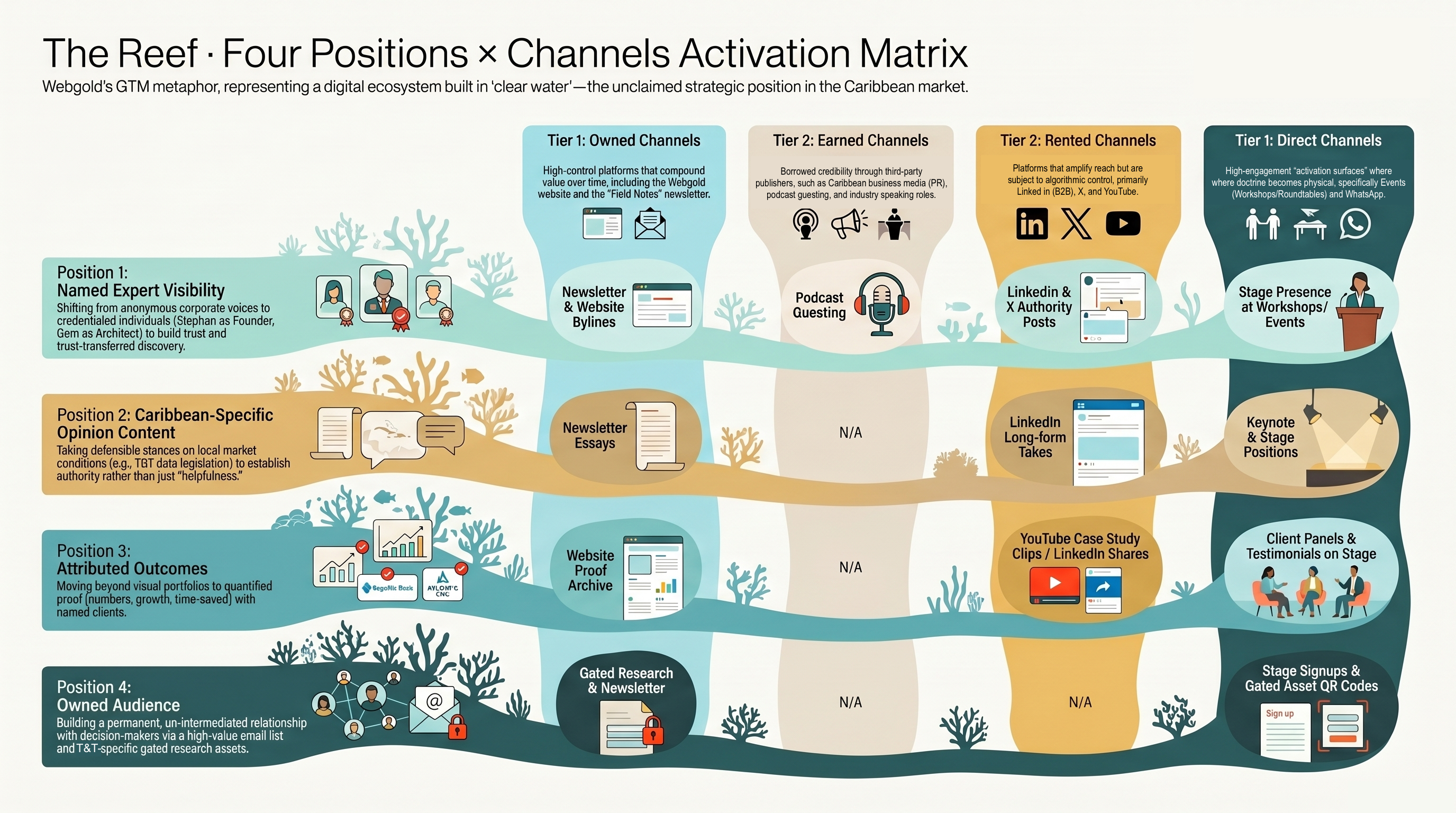
The four signals from the white-space claim become the four positions Webgold commits to actively building. Each is defined here with what it means, why it is the right choice, how it is operationally built, and how it is measured. The Filter validates against each. Every Harmony Calendar entry cites which position(s) it advances. A motion that advances none of the four does not ship.
Position 1 — Named Expert Visibility
Every motion that originates from Webgold has a named human attached to it where the channel allows it. Blog posts are bylined. Newsletter sends are signed. LinkedIn content has a face. Speaker appearances have a credentialed person on stage. Case studies have named consultants on the engagement. The default for Webgold output is named, not anonymous.
The named-author architecture is intentionally distributed. The Reef compounds because many credible voices are visible at once, not because two voices publish constantly. Webgold authors as a team — founder voice, specialist voices across the service lines, marketing voices, and architect voice — each named, each with their own territory, each on their own cadence.
Founder voice — Stephan De Roche, CEO. Organic, not orchestrated. Stephan publishes when a topic compels him: Caribbean digital transformation, regulatory environments, AI procurement, board-level strategic questions. The Founder Positioning Brief articulates territory and voice attributes — what he writes about and how he sounds — but does not impose a publishing schedule. Anchor authority signal; high-volume natural writer in his own right.
Specialist voices — named experts across the service lines. Each WG-25 sprint surfaces a named expert: Support, Commerce, Development, Engagement, Products, Growth, Content, Identity, Intelligence, DX/Transformation. Minimum cadence one bylined piece per quarter once activated; many publish more frequently because the cadence flexes with the natural rhythm of the person and the territory. Specialist voices carry the bulk of the published volume because they are closest to the work.
Marketing voices — the Webgold marketing execution layer. Per the Org Structure: Gem David holds Marketing Lead (Webgold Authority & Beacon) in dual capacity until Yohance Quamina-Boyce (Visual & Brand Strategist, research-integrative) is elevated. Anyah McNeill (Copy & Messaging Strategist, conditional, research-integrative) owns copy and messaging. Kevyn (Marketing Assistant, 40% retainer through end-2026) supports execution. Author on the discipline of Caribbean digital marketing, case study introductions, cross-cutting framing pieces. Their own cadence per the Marketing Lead's editorial calendar, integrated into the Harmony Calendar which feeds CON-002 Editorial Calendar in the Nucleus.
Programme architect voice — Gem David. Architecture, methodology, build-in-public progress, system-level reasoning. Moderate cadence (target minimum one bylined piece per fortnight). One contributor among many — not the volume engine.
Orchestration role — Gem David, separately from the architect voice. Filter, Tempo Gate, Harmony Calendar, channel-mix coordination, editorial calendar, named-author onboarding pack. Distinct function from authoring. Gem leads the marketing effort by orchestrating, not by writing the bulk of the content. The two roles are kept distinct in the doctrine because conflating them either over-weights architect voice or under-weights orchestration discipline.
Cadence: Stephan minimum one bylined piece per month from Sprint 1; Gem minimum one bylined piece per fortnight; named contributors minimum one per quarter once activated. Measurement: byline count per quarter (target 6+ per quarter from Q3 2026); audience response per author; citation frequency in third-party sources.
Position 2 — Caribbean-Specific Opinion Content
A consistent stream of published positions on T&T and Caribbean market conditions, where the position is specific, defensible, and willing to disagree publicly. Not the how-to genre. Opinion content — here is what is happening, here is what we believe is wrong about how the market is reading it, here is what should be done instead.
Editorial standard: a named position by paragraph three, a piece of evidence by paragraph five, a clear what-we-believe statement at the close. Pieces that fail these criteria do not ship. Cadence: minimum two opinion pieces per quarter from Q3 2026; ramping to four per quarter by Q1 2027. Measurement: opinion-piece count, share/link/cite ratio, inbound discovery calls citing specific Webgold opinion pieces.
Position 3 — Attributed Outcomes
Every material client engagement produces a published case study with named client, named consultant(s), named brief, and quantified outcome. Outcomes are numbers — not adjectives. Confidential engagements are honoured but do not surface in the proof archive.
Operationally produced through the Proof Factory (§9). Three historical anchors — Republic Bank, Atlantic LNG, MultiBank — are the Sprint 1 through Sprint 4 publishing priority. Cadence: minimum one per quarter from Q3 2026; ramping to one per fortnight by Q4 2026. Measurement: outcome-metric coverage (target 100%); conversion rate from case study read to discovery call request.
Position 4 — Owned Audience
An email list of T&T and Caribbean business decision-makers, built and owned by Webgold, that grows through gated research assets and a regular newsletter cadence. The list is the only channel where Webgold has a direct, unintermediated relationship with every subscriber.
First gated asset (T&T Digital Marketing Benchmark 2026) launches Sprint 2. Newsletter (Webgold Field Notes, working title) launches Sprint 1 with 100-subscriber seed. Cadence fortnightly to Sept 14, weekly post-launch. Targets: 500 subscribers by end Q2 2026, 2,000 by end Q4 2026. Measurement: list size, engagement rate, conversion from list to discovery call.
Events as activation surface
Events activate Position 1 live — a speaker walks on stage with a name, a face, a credential. The audience verifies in real time. There is no anonymous corporate voice possible. The audit confirmed no firm in the T&T market combines named expert visibility with active publishing; events are how the named expert becomes verifiable before the publishing archive has compounded.
Events activate Position 2 at the moment of highest authority signal — an on-stage opinion delivered to a curated audience and recorded for distribution carries authority that the same opinion delivered as a blog post does not. The audience is part of the credentialing.
Events activate Position 3 with the client's own voice in the room — a case study presentation that includes the client on the panel, naming themselves, describing the engagement, attesting to the outcome with the named consultant beside them, is the highest-conviction proof signal available in any channel.
Events activate Position 4 at the moment of highest engagement — the newsletter signup invitation made from the stage at the close of a workshop or roundtable converts at a rate no website footer ever achieves. The gated research asset offered as the take-home from an event drives list growth that no organic channel matches.
This is why the events programme is treated in the Spine as primary infrastructure rather than as supplementary marketing. The Webgold Events Programme Warfare Doctrine and the WG-21.5 events programme are the operational layers; the Spine commits the company to running them as the activation surface for the four positions through 2026 and into 2027. §7 (Channel Hierarchy) gives events full treatment as a primary channel. §10 (Kill List) names what events we deliberately do not run.
How the four positions activate across channels
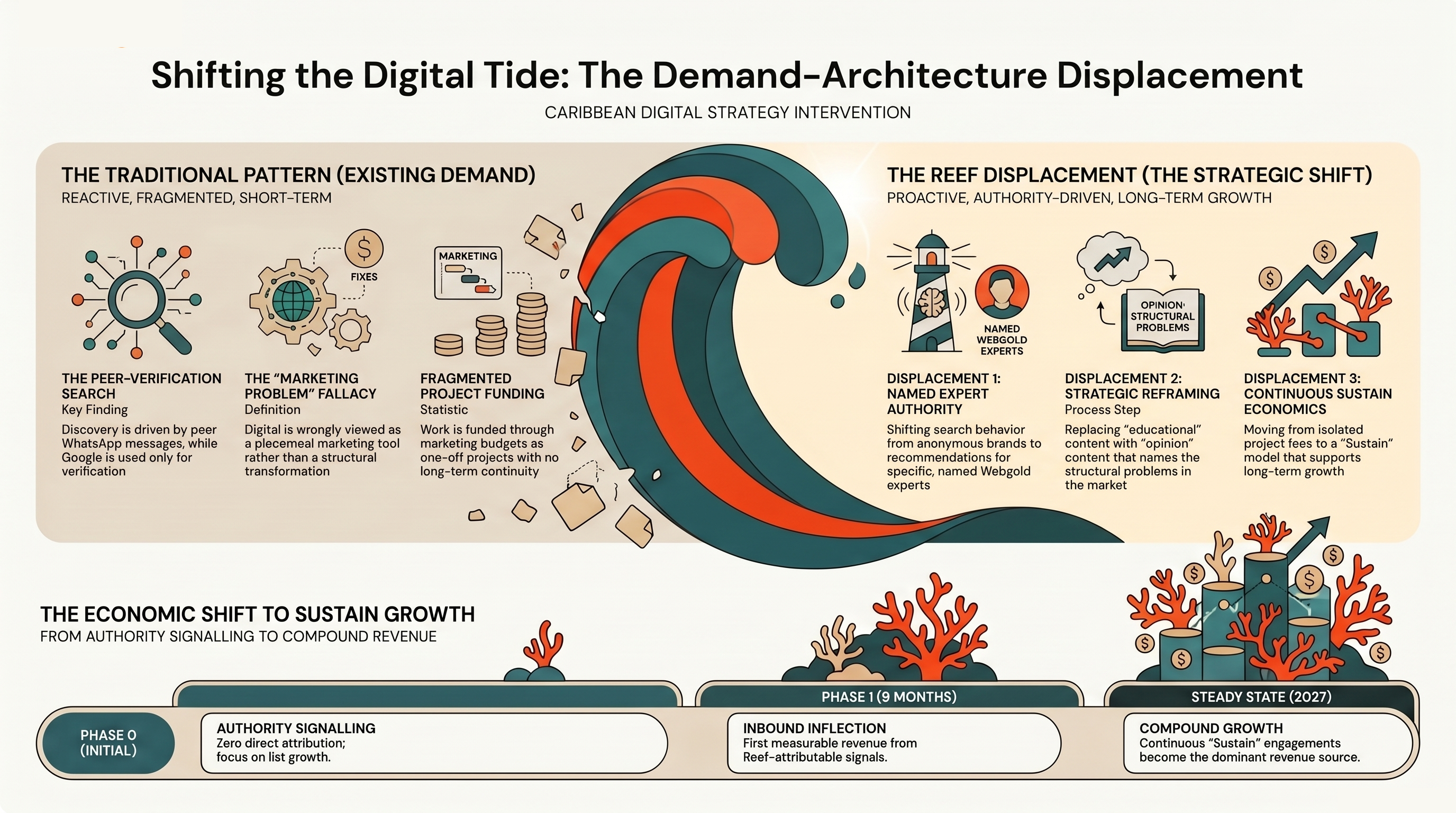
The Webgold Master GTM does not enter an existing demand pattern; it changes the demand pattern. This section maps the current demand architecture in the T&T market — how prospects currently search for digital help, what they currently believe digital is, and what they currently fund in pursuit of it — and names the displacement intervention by which the Reef changes each of those three layers.
How T&T businesses currently search
The dominant search behaviour is a four-step pattern. A business problem surfaces. The decision-maker reaches first for peer reference — a phone call to a fellow CEO, a Chamber of Commerce conversation, a WhatsApp message to a trusted advisor. Names get exchanged. The shortlist is compiled from those names plus past LinkedIn impressions or industry events. Google search is used to verify the firms on the shortlist — but rarely to discover firms not already on the list. The process closes with one or two discovery calls and a hire.
Three implications. One: the discovery channel is overwhelmingly social — peer recommendation. The Reef investment in named-author publishing, opinion content, and event presence is therefore optimising to be the firm peers recommend by name when asked. Two: Google is the verification channel. The website, team page, case studies, blog, event archive are not for discovery; they are for verification. They have to pass the verification test the moment a peer makes the recommendation — which is one of the reasons the WG-25 staging copy audit cannot be deferred. Three: the Big Four have a structural advantage in peer-recommendation because the recommendation is often "you could call PwC" rather than a specific person; named-expert positioning displaces the Big Four advantage by making the recommendation a specific named human at Webgold.
What T&T businesses currently believe
The dominant belief in the T&T market about digital is that digital is a marketing problem. The belief follows from how digital was sold from 2010-2025: as channels, campaigns, content, social media, paid ads. Marketing-problem framing means digital investment is funded out of marketing budgets, decided by marketing leaders, evaluated against marketing KPIs, and treated operationally as a marketing function.
Secondary assumptions the Reef must displace: that international firms are more expert than regional firms (Big Four perception); that technology choices are commodity selections (any agency can build a website; pick the cheapest or most polished); that the right scope of digital work is project-based with a defined deliverable rather than continuous strategic engagement; that strategy and execution are separable; that what works in the United States works here with minor localisation; that AI is either a distant future concern or a feature embedded in the next tool. Each of these is structurally wrong for the Caribbean market and costs prospects measurable money every year they hold it.
What T&T businesses currently fund
Marketing budgets fund digital work in the TT$10,000-50,000 range per engagement for SMEs and TT$50,000-250,000 for mid-market. Enterprise digital transformation work, where it happens, is procured through tenders, IT departments, and global firm relationships. Continuous retainer relationships are rare and unstable. The most common funding pattern is project-based with a defined start and end and the expectation that the agency leaves at delivery.
This is why the Solution Suites tier system (Clarity / Command / Intelligence) is the right operational pricing structure: it matches existing funding patterns while naming the value differently — not project deliverables, but tier-appropriate strategic engagements with explicit Sustain commitments.
The displacement intervention
One — displace the search pattern. Become the firm peers recommend by name. Named-expert publishing (Position 1) is the mechanism. When a CEO asks another CEO who they would call, the answer becomes a specific human — Stephan, or Gem, or a named Webgold expert — rather than a brand. Verification then passes because the website, team page, case studies, published archive all confirm what the peer just said.
Two — displace the belief pattern. Publish opinion content (Position 2) and case studies (Position 3) that reframe what digital is. A piece by Stephan on T&T regulatory environment shaping AI procurement is a strategic piece, not marketing. A case study quantifying operational impact is a transformation outcome, not a campaign portfolio. The Reef does not argue the belief is wrong in the abstract; it publishes content that demonstrates a different framing in the specific. After twelve months, prospects have begun to believe digital is something other than a marketing problem.
Three — displace the funding pattern. Work inside the existing funding structure (the Solution Suites pricing) while educating the buyer that Sustain is not optional. Every engagement closes with a Sustain conversation. Every case study includes a Sustain element. After eighteen months, the proportion of revenue from continuous engagements grows materially. After thirty-six months, continuous engagements are dominant. That is when the funding displacement is complete.
The after-state
The Reef in steady-state — by mid-2027 in the most ambitious projection, late 2027 in the conservative one — operates inside a market in which the search pattern has begun to discover Webgold authors before peer reference; the belief pattern has begun to acknowledge digital as a transformation discipline; and the funding pattern has begun to allocate continuously rather than only project by project.
This is what success looks like for the Master GTM. Not lead volume in 2026. Not pipeline numbers in Q3 2026. Not a closed-deal count by Sprint 7. Success is whether the demand architecture has begun to shift. The Tempo Gate tracks early signals — the share of inbound discovery calls citing Webgold-published content as origin, the share of opinion pieces being referenced in third-party content, the share of case studies driving measurable inbound activity, the share of revenue from continuous engagements. By Q1 2027 these signals should be measurable, repeatable, and growing month over month.
Every motion that ships from Webgold belongs to one of four content categories. The categories are mutually exclusive and collectively exhaustive — every piece sits in exactly one category. The categories are weighted differently per phase and per channel within a phase. The ratios published in this section are the starting points; the Tempo Gate adjusts them weekly in response to live conditions.
The four categories
Category 1 — Informational, educational, authority. Content establishing Webgold's thinking about T&T market, digital landscape, strategic questions. Opinion pieces, founder essays, framework explainers, market analyses, named-author thought leadership. Dominant in early phases.
Category 2 — Brand / promotional. Content that says what Webgold is, what we offer, what we stand for. Brand statements, value-proposition expressions, service-line introductions. Necessary but never dominant. Earns its place by carrying authority signal or proof signal alongside.
Category 3 — Sales / product / service. Content driving toward a specific commercial action. Service-line landing pages, Patch product pages, case studies inviting discovery conversation, email nurture sequences post-event. Gated behind authority and proof.
Category 4 — Event. Content that promotes, recaps, extends, or distributes a Webgold-attached event. Sprint-bound through 2026. Highest-leverage during event-week phases.
Ratios per phase
Authority / Brand / Sales / Event — visualised:
Three things to read in this table. First, authority remains dominant through every phase except CommUnity event week (Sprint 4) — even post-launch, authority share remains 50% because authority is the structural foundation of the Reef. Second, sales rises gradually as the website matures and proof accumulates. Third, event content surges around CommUnity 2026 (Sprint 4) and remains a steady 15-20% because events are the primary activation surface, not a supplementary motion.
Ratios per channel
Channels carry different mixes within a phase. Tempo Gate adjusts per channel in response to live engagement.
Newsletter and LinkedIn carry the highest authority weight because they are the channels where named-author publishing builds the four positions most directly. The website carries more brand and sales weight because it is the verification surface for prospects arriving from peer recommendation. WhatsApp and email nurture carry sales weight because they engage prospects already in the funnel. Facebook is the most mixed channel and the lowest-leverage; it is the first pulled back by the Tempo Gate.
Webgold operates four channel tiers. Owned channels compound. Rented channels amplify. Earned channels borrow. Direct channels engage. The Reef invests in owned and direct first; rented amplifies; earned borrows authority that the Reef will eventually have on its own.
Tier 1 — Owned Channels
Role: verification surface for prospects arriving from peer recommendation. Not a discovery channel; it is where prospects who have heard our name come to verify we are real, current, substantial.
Cadence: continuous — every WG-25 sprint adds new substance. Owner: Gem until Sprint 1, then per service line. Failure mode: stale content, broken links, lorem ipsum, banned-vocabulary verification failures.
Role: habitual relationship channel. The only channel where Webgold has a direct, unintermediated relationship with every subscriber.
Cadence: fortnightly Sprint 1 → Sept 14, weekly post-launch. Owner: Gem authoring; rotation with named contributors. Failure mode: open rate sustained below 25%, reply rate below 1%.
Role: post-trigger relationship deepening. Runs after a prospect has shown specific interest. Cadence: triggered, not scheduled. Owner: Gem orchestrating. Failure mode: reply rate below 1% sustained across multiple sequences.
Role: list-building exchange. T&T-specific research substantial enough that a decision-maker exchanges an email address for it. First asset Sprint 2; second Sprint 5; third at full launch. Cadence: 4-6 per year. Owner: Gem authoring; Stephan rules on positioning. Failure mode: download-to-newsletter-conversion below 60%; asset-attributed discovery calls below 5% of total inbound.
Tier 2 — Earned Channels
Role: borrowed credibility. Cadence target: minimum one placement per quarter from Sprint 1. Owner: Gem orchestrating; Stephan or Gem as named expert. Failure mode: zero placements per quarter sustained.
Role: audio-first authority reach. Cadence target: minimum one appearance per quarter, scaling to monthly post-launch. Owner: Gem orchestrating. Failure mode: zero appearances per quarter sustained.
Role: live authority at industry conferences not run by Webgold. WG-21.4 currently paused; reactivation expected from Sprint 4 onwards.
Tier 2 — Rented Channels
Role: primary B2B authority channel. The audit confirmed named-author publishing on LinkedIn for T&T is structurally underserved. Mix: 65/15/10/10. Cadence: minimum 2 posts per week per active named author from Sprint 1. Failure mode: no named author publishing for two consecutive weeks.
Role: visual brand and event extension. Mix: 30/30/20/20. Cadence: 1-2 posts per week. Failure mode: follower growth flat over a quarter.
Role: text-heavy authority and commentary on T&T digital sector. Mix: 70/10/10/10. Cadence: 1-2 posts per day from active named authors.
Role: community-broad reach for T&T businesses operating Facebook-primary. Lowest-priority Tier 2. Mix: 25/25/25/25. Cadence: 2-3 posts per week.
Role: long-form video — event recordings, presentations, named-author talks. Mix: 50/20/10/20. Cadence: minimum 1 video per fortnight from Sprint 1.
Per DEC-019, TikTok is deferred for the entire 2026 build. The platform is named in the Kill List (§10). Reactivation is a Phase 1 (post-September 15 2026) decision and requires explicit re-evaluation.
Tier 1 — Direct Channels
Role: primary activation surface for the four positions through 2026. The Webgold Events Programme Warfare Doctrine is the operational layer.
Cadence: per Warfare Doctrine — workshops monthly from Sprint 1, executive roundtables quarterly, industry seminars per Sprint, CommUnity 2026 sponsorship Jul 2 (PRos & COMMS), Caribbean Digital Awards 2027, Caribbean Digital Transformation Conference as 3-year flagship destination. Owner: Gem orchestrating end to end; Stephan as primary stage presence. Failure mode: rooms not filling, no named clients on panels, generic networking dominating, sales pitches creeping into stage content.
Role: direct relationship maintenance per Caribbean business norms. Mix: 20/30/30/20. Cadence: per relationship; not scheduled. Failure mode: relationship attrition.
Role: trust-transferred discovery. Cadence target minimum 5 referred discovery calls per quarter from Sprint 4. Owner: Gem designing; Stephan ratifying; existing clients as referrers. Failure mode: zero referred discovery calls per quarter sustained.
What v1.0 commits to structurally
The architecture is multi-voice from the start. Webgold authors as a team, not as a founder-and-architect duo. The Reef's authority signal compounds because many credible voices are visible at once. The lanes below describe each named-author role; v1.1 of the Spine populates the operational specifics for each on FPB delivery.
Founder voice — Stephan De Roche, CEO. Organic, not orchestrated. Stephan publishes when a topic compels him: Caribbean digital transformation, regional regulatory environments, AI procurement, board-level strategic questions, the strategic shape of the Reef itself. Cadence is his to set. Some weeks nothing; other weeks several pieces. Stephan is the company's anchor authority signal and a high-volume natural writer; the architecture treats him as both. The FPB articulates territory and voice attributes — what he writes about and how he sounds — but does not impose a publishing schedule. Founder voice is opinion-first when it ships; the volume is a function of what compels Stephan, not of a scheduled cadence.
Specialist voices — named experts across the service lines. Each WG-25 service-line activation surfaces a named expert: Support lead in Sprint 1, Commerce specialist in Sprint 2, Development lead in Sprint 3, three voices simultaneously in Sprint 4 (Engagement, Products, Growth), Content and Identity leads in Sprint 5, an Intelligence / AI strategist in Sprint 6, a DX/Transformation lead in Sprint 7. Minimum cadence one bylined piece per quarter once activated; many publish more frequently because the cadence flexes with the natural rhythm of the person and the territory. Each specialist voice is process-led on their own discipline. Specialist voices carry the bulk of the published volume because they are closest to the work.
Marketing voices — the marketing execution layer as authors. Per the Webgold Org Structure: Gem David holds Marketing Lead (Webgold Authority & Beacon) in dual capacity until Yohance Quamina-Boyce (Visual & Brand Strategist) is elevated to the role. Yohance owns the visual and brand expression layer — research-integrative. Anyah McNeill (Copy & Messaging Strategist, conditional) owns copy and messaging — also research-integrative. Kevyn (Marketing Assistant, 40% retainer through end-2026 due to nursing programme) supports execution. Marketing voices author on the discipline of Caribbean digital marketing specifically, on case study introductions, on cross-cutting framing pieces. Cadence per the Marketing Lead's editorial calendar, integrated into the Harmony Calendar (Phase 4 of the cascade) which feeds CON-002 Editorial Calendar in the Nucleus content production chain.
Programme architect voice — Gem David. Architecture, methodology, build-in-public progress on the GTM cascade itself, system-level reasoning. Moderate cadence (target minimum one bylined piece per fortnight) — substantive enough to register as a named voice, not the volume engine. Specific audience: technical buyers, partners evaluating Webgold's build approach, prospects who care how the work gets done. That audience is meaningfully smaller than the founder-voice or specialist-voice audiences; the cadence reflects this. One contributor among many.
Orchestration role — Gem David, separately from the architect voice. The orchestration role is distinct from the authoring role and should not be conflated even though the same person holds both. Orchestration runs the Filter, the Tempo Gate, the Harmony Calendar, the channel-mix coordination, the editorial calendar, the named-author onboarding pack. Orchestration is what makes the multi-voice architecture coherent. Gem leads the marketing effort by orchestrating, not by writing the bulk of the content. The two roles are kept distinct in this Spine and across all derivatives because conflating them would either over-weight architect-voice content (wrong for the Reef) or under-weight the orchestration discipline (which is what holds the multi-voice architecture together).
What v1.1 will populate after FPB delivery
Stephan's editorial territory (specific topics he commits to publishing on); Stephan's cadence commitment; founder voice attributes (tone, register, perspective, point-of-view stance); the founder positioning statement as a reusable canonical paragraph for biographical references across all surfaces; the bylined contributor structure (review process, voice consistency standard, named-author onboarding pack); and the editorial standard for opinion pieces (the position-by-paragraph-three rule, the evidence-by-paragraph-five rule, the what-we-believe close).
Until v1.1 cuts, no founder-voice content ships from Webgold without explicit Stephan ratification. Service-line authors are not blocked — they may begin publishing under their own voices in their own service-line territory — but the founder voice does not begin its public cadence until the FPB is the active operating reference.
Position 3 (Attributed Outcomes) requires Webgold to publish case studies with named clients, named consultants, named briefs, and quantified outcomes. The Proof Factory is the system that produces those case studies. It is not an ad-hoc effort. It has triggers, an intake flow, a consent process, an authoring rhythm, a publishing cadence, a distribution sequence, and a repository governance model.
The triggers
Three trigger types flag a case study candidate. Milestone triggers — any client engagement reaching a named milestone (go-live, first measurable outcome, twelve-month anniversary, contract renewal). Outcome triggers — any engagement producing a quantifiable result above an internal threshold within thirty days of the result being measurable. Anchor triggers — Webgold's historical anchor clients (Republic Bank, Atlantic LNG, MultiBank) are perpetual candidates with a standing assignment to convert them starting Sprint 1.
The intake form
Every candidate is logged in the Airtable PROOF_CANDIDATES table at the moment of trigger. Fields: candidate name, trigger type and date, named Webgold consultant, named Webgold author, brief summary, scope, outcomes measurable to date, outcome metrics with specific numbers, client testimonial captured (yes/no, with date), client logo permission, client photo permission, expected publication sprint, distribution plan per channel. Filled by the named consultant within one week of trigger; reviewed by Gem within week two; assigned to a named author by end of week two.
The client consent flow
Consent captured before drafting begins. The Webgold Case Study Consent Letter is canonical. Permissions requested: name client by company name, name by individual contact, use logo and brand mark, quote client in their own words, publish quantified outcomes, distribute across all relevant channels, retain in archive in perpetuity. Consent revocable up to thirty days post-publication; non-revocable after. Signed by authorised client representative; counter-signed by Stephan as Webgold CEO. Partial-consent case studies are not produced — partial consent is operationally unstable.
The authoring rhythm
Each case study authored by a named Webgold author working with the named consultant. Author drafts; consultant fact-checks; Gem editorially reviews against the four-position commitment and the Filter; Stephan ratifies. Drafting begins after consent and outcome metrics confirmed; fourteen-day target start to ratified version. Canonical format: title, client name and logo, scope (2-4 sentences), named consultant and role, outcome with specific numbers, client testimonial in named voice, date and duration, Sustain element. Missing elements returned for completion.
The publishing cadence
Minimum one published case study per quarter from Q3 2026, ramping to one per sprint (per fortnight) by Q4 2026, sustained at one per fortnight from Q1 2027. Anchor case studies — Republic Bank, Atlantic LNG, MultiBank — are the publishing priority for Sprints 1-4.
The distribution sequence
Every published case study runs the same four-week distribution sequence. Week 1: case study lives at /case-studies/[client], announced in next newsletter, posted by named author on LinkedIn, posted by Stephan as founder-voice ratification, X thread. Week 2: 60-90-second video clip on YouTube; companion Instagram and Facebook posts. Week 3: referenced in a follow-up named-author opinion piece drawing a generalisable lesson. Week 4: added to next event's talking points if event in the next four weeks. After the four-week sequence, lives in the proof archive and surfaces on relevance.
Repository governance
Three locations canonically. Website at /case-studies/[client] is the public canonical version. Airtable PROOF_ARCHIVE is the operational reference. CMIF Source Document Register is the strategic register. Three-copy sync rule applies for any case study updated post-publication.
A doctrine that names everything it does without naming what it refuses produces the same drift the white-space audit found in fifteen competitors. Authority requires refusal as much as it requires commitment. The Kill List names what the Master GTM rules out for Phase 0 of the Reef.
| Category | Refusal | Status |
|---|---|---|
| Channels | TikTok deferred for entire 2026 build (DEC-019). Audience composition unfavourable for T&T B2B; production cost high; named-author signal does not transfer cleanly. Reddit, Threads, Twitch similarly deferred. | SETTLED |
| Content types | Generic SEO content (listicles, how-to articles, best-practices roundups). Position is occupied; differentiation does not exist. Undifferentiated thought leadership using corporate-voice authority signals (banned by guardrails). Marketing-services-vendor positioning (we are not a marketing service provider). | SETTLED |
| Audiences | Broad consumer commerce. Undifferentiated B2B lead generation (cold outbound, list-buying, sequencing software). Anyone wanting a one-off brochure website with no strategic engagement underneath. | SETTLED |
| Vocabulary | Per WEBGOLD MESSAGING GUARDRAILS v1.0, the Filter strips: "solutions" as standalone noun, "transform your business" without mechanism, "world-class," "innovative" without specifics, "passionate," "leverage" (corporate-speak), "game-changing," "seamless," "bespoke" generically, "full-service," "in today's digital landscape," "in today's digital age." Full list in Messaging Guardrails. DEC-MGTM-001 RESOLVED. | SETTLED |
| Events | Cold sales pitches from stage. Generic networking-only. Sponsorships at events that do not fit territory sequencing (BB before Year 2 = no). Vendor-booth-only appearances where presence does not earn the room. Government-engagement-as-pipeline (per Warfare Doctrine, government figures are partnership contacts, not commercial leads). | SETTLED |
| Held under review | Paid media activation before authority signal established (Phase 0 only; reactivation Sept 15+). International territory entry (2026 = TT only; BB/JA/GY = 2027). Solution Suite scope expansion beyond seven existing tiers (Phase 0 only). | REVIEW |
The Kill List is governed alongside the rest of the Master GTM. Additions, removals, and status changes are decision-logged in the DEC-MGTM-* series and the Spine version-bumps to reflect them. The Filter operationalises the Kill List in real time. The Tempo Gate does not amend the Kill List; only the Spine itself can.
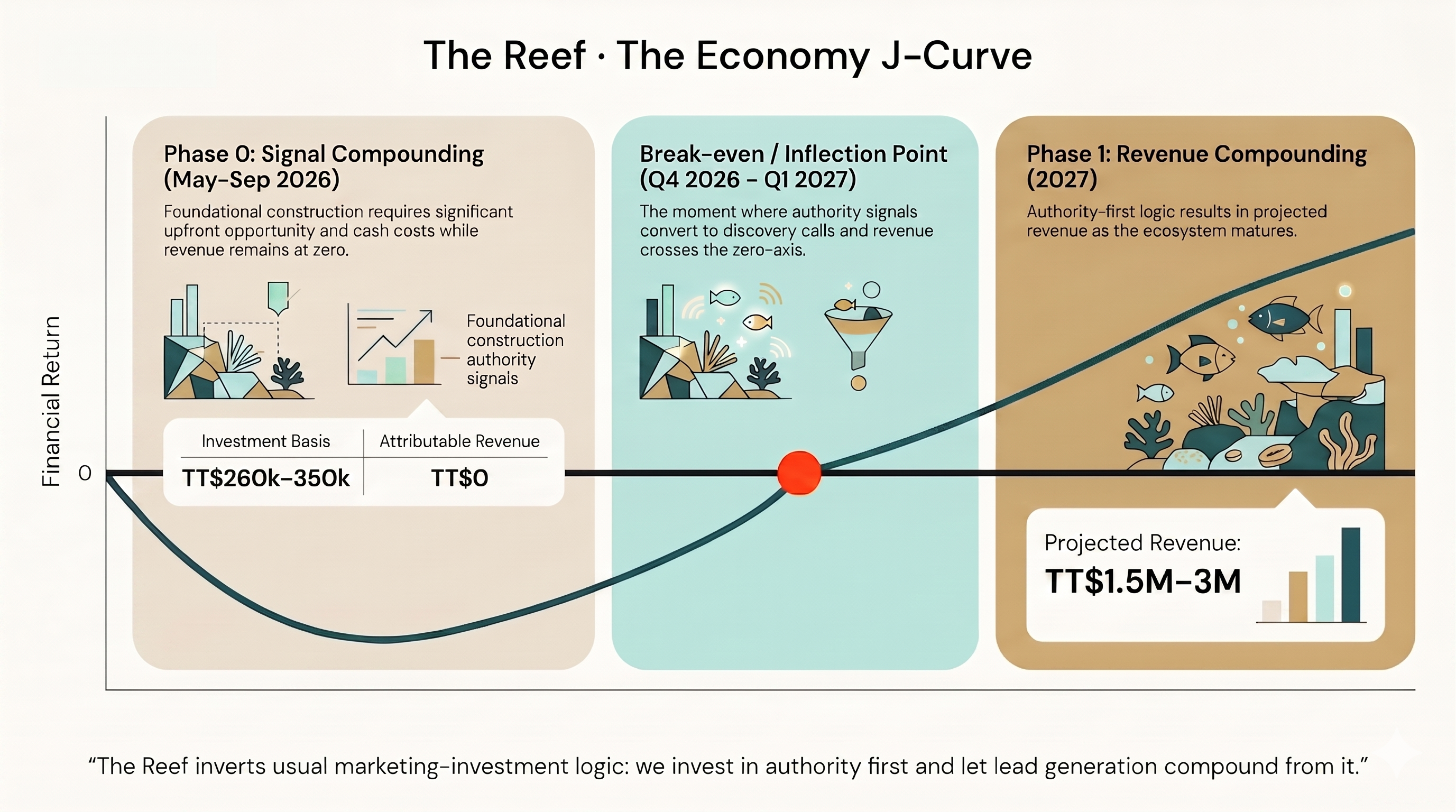
Every doctrine document that does not state its economic shape is a wish. Every number in this section is a working assumption flagged for validation by Gem and Stephan; v1.1 of the Spine will refine with actuals.
Cost basis (estimated)
Internal hours, Phase 0 (May → Sep 14): ~800 hours sustained from Gem (Reef end to end), Stephan (founder voice, ratification, stage presence), service-line contributors (sprint by sprint). At notional rates, opportunity cost of approximately TT$240,000-320,000 across the four months. Agency / freelance cash: ~TT$18,000-27,000 (existing WG-21 budget basis Q3-Q4 2026). Total Phase 0 economic investment: ~TT$260,000-350,000 equivalent.
Phase 1 (Sept 15+) adds paid media. Working assumption: TT$5,000-10,000 per month from October 2026, ramping to TT$15,000-25,000 per month by Q1 2027 if signals support.
Time investment per phase
| Phase | Gem | Stephan | Service-line authors |
|---|---|---|---|
| Pre-MVP (now → Apr 30) | ~50 hrs/week | 5-10 hrs/week | Ad-hoc |
| Sprints 1-7 (May 1 → Aug 6) | ~40 hrs/week sustained | 8-12 hrs/week sustained | 10-15 hrs/week (rotating) |
| Buffer (Aug 7 → Sep 14) | ~25 hrs/week | 5 hrs/week | Reduced |
| Full launch (Sept 15+) | ~35 hrs/week sustained | 8-10 hrs/week | 15-20 hrs/week aggregate |
Expected return curve
| Period | Reef-attributable revenue (working assumption) | What's true |
|---|---|---|
| Q3 2026 (Sprints 1-3, May-June) | Operationally zero | Authority signals only. Newsletter list 100 → 300-400. First case study (Republic Bank). First gated asset live. |
| Q4 2026 (Sprints 4-7 + buffer) | TT$50,000 - 100,000 | First measurable inbound. Newsletter 300-400 → 700-900. CommUnity sponsorship lands. 3-4 case studies live. The inflection quarter. |
| Q1 2027 (post-launch) | TT$250,000 - 500,000 | Sustained inbound from Reef. Newsletter 1,500-2,000. 6-8 case studies. Continuous Sustain engagements measurable. |
| 2027 calendar year | TT$1.5M - 3M | Reef compounds. Continuous engagements dominant. Territory expansion (BB, JA, GY) begins. |
The honesty
This is Phase 0 of a five-year build. The economics are slower than a project-pipeline build for the first nine months. Break-even — when Reef-attributable revenue covers operating cost — is projected for late Q4 2026 / early Q1 2027 ambitious case, end Q1 2027 conservative. Before that moment, the Reef consumes opportunity cost without producing comparable revenue, which is the correct shape for an authority-first investment. After that moment, the economics invert: revenue grows faster than cost.
The patience required to hold to the doctrine through the sub-break-even period is the single biggest risk to the Master GTM. The Tempo Gate is the mechanism that protects against premature pivot — it makes the early signals visible weekly and reminds the team that the trajectory matters more than the volume.
CMIF inheritance — what flows in
The CMIF is a primary source for several Spine sections. Personas (Sam, Grace, Edwin, Garvin, Maya) inform §5 and §7. The April 2026 white-space analysis is the substrate for §3. Channel intelligence by territory informs §7. The decision register is upstream of DEC-MGTM-*. Relevant CMIF decisions (DEC-019 TikTok deferral, Solution Suite tier confirmations, WG-21.5 Events Programme registration, Brand Launch rollout integration) are cited as canonical inputs.
CMIF — what flows back out
On Spine v1.0 publication, the Master GTM is registered as a canonical source document in the CMIF Source Document Register (Phase 8.1 of the cascade). CMIF version-bumps to v1.2. Every subsequent Spine version increment triggers a CMIF Source Register update. New DEC-MGTM-* decisions mirror in the CMIF where they have cross-project implications.
Service GTM relationships
Previously called "Sub-GTM" in earlier cascade docs; renamed Service GTM per DEC-MGTM-NEW-01 (Content Command convention adopted). Same concept; new label.
| Service GTM | Inherits from Spine | Owns |
|---|---|---|
| WG-21 (Strategic Marketing & DX Authority) | Full Spine doctrine, four-position commitment, content portfolio mix, channel hierarchy, Kill List, Authorship Architecture (placeholder until v1.1). | Marketing programme execution, sub-project coordination across WG-21.1-21.6. |
| WG-21.1 (DX Authority) | §1, §2, §4 Position 1, §4 Position 2. | DX positioning programme, founder/architect thought leadership, signature IP development. |
| WG-21.2 (Channel Architecture) | §6, §7, channel-specific failure modes. | Per-channel architecture decisions, distribution sequencing, analytics dashboard. |
| WG-21.3 (Content Engine) | §6, §4, editorial standard. | Editorial calendar, content production system, HITL workflow, monthly publishing volume target. |
| WG-21.4 (Strategic Partnerships) | §7 earned-channel architecture, §10 events Kill List. | PR relationships, speaking engagement booking, partnership development. Currently paused. |
| WG-21.5 (Events Programme) | §1 build-as-attraction, §4 events as activation surface, §7 events under Direct, §10 events Kill List, the Warfare Doctrine. | Events execution, territory sequencing, event format ladder, persona-to-format mapping, CommUnity 2026. |
| WG-21.6 (Social Presence) | §6 channel-specific mixes, §7 rented-channel architecture (TikTok deferred). | Social presence activation across six approved channels, template production, social cadence. |
| WG-25 (Website) | §1 verification surface, §6 website mix, §7 website channel role, §10 banned vocabulary. | Website build, sprint activations. Filter has authority over WG-25 staging copy per DEC-MGTM-001. |
| WG-14.3 (Service Architecture) | §4, §5 demand-architecture (funding pattern), §11 Economy. | Solution Suite scope, Patch catalogue, SOW positioning, tier system, pricing. |
| BC-22 (Buzz Media) — future | §1, §4 (adapted for SaaS), §10 principles. | Buzz Media GTM under construction in 2027. |
| BX-23 (Buzz Experiences) — future | §1, §4 (adapted for B2C travel), events doctrine. | Buzz Experiences GTM under construction in 2027. |
No Service GTM may publish doctrine that conflicts with the Spine. Where a Service GTM execution decision needs to ship before the Spine has been updated, the Filter is the holding pattern. The Filter is the bridge between Spine doctrine and Service GTM execution.
The Reef Team Briefing cross-walk
| Metaphor | What work it does | When to use it |
|---|---|---|
| Vehicle (Pipes/Engine/Shield/Beacon) | How the company is structured and how it delivers. Macro-programme architecture. | Webgold-wide programme planning, project execution, organisational capacity, the 2028 destination, the four pillars. |
| Beacon (one of four pillars) | The authority and visibility programme of the Webgold Organism. | What we light up, what we are visible on, our authority signal as a programme. Reef is what the Beacon casts light on. |
| Riverlets | Per-offering go-to-market journey. Each offering has its own Riverlet that flows toward the Reef. | A specific offering's prospect journey, conversion sequence, or buyer mechanics. WG-21 Documents reference this. |
| Warfare (Events Doctrine) | The territory-acquisition doctrine governing events. Appearance → Community → Education → Authority → Dominance. | Event format selection, territory sequencing, persona-to-format mapping, government-vs-commercial event audience separation. WG-21.5 owns. |
| Symphony | The harmony of all motions running concurrently. The orchestration metaphor. | The Tempo Gate, the Harmony Calendar, the 13-week rolling view, the harmony-of-exposure principle. |
| Reef (Master GTM Spine) | The governing metaphor of the Master GTM. Build-as-attraction. The ecosystem we build to attract the prospects we want. | The Master GTM doctrine, the four-position commitment, the demand-architecture displacement, the white-space claim, the build-in-public principle. |
The metaphors do not collide. They describe different layers of how Webgold Designs Ltd operates inside the wider Webgold organism. The Reef is the Master GTM governance layer for Webgold Designs Ltd specifically; the Organism layer above carries the company group context (Webgold Designs + Buzz Media + Buzz Experiences); the operational layers (Vehicle, Beacon, Riverlets, Warfare, Symphony) work across one or more entities depending on their scope. The Reef Team Briefing (Phase 7 of the cascade) packages this cross-walk into a one-page printable reference and a 30-minute team session deck. Until that briefing runs, this section serves as the canonical cross-reference for any team member or external collaborator unsure which metaphor to use in a given context.
The Reef and the Master GTM govern Webgold Designs Ltd marketing only. Buzz Media and Buzz Experiences are sister entities within the Webgold organism but are NOT in the Master GTM's scope. They will receive their own future GTMs (BC-22 Buzz Media Marketing in 2027, BX-23 Buzz Experiences Marketing in 2027) following the same cascade methodology, adapted for SaaS and B2C travel. Where another entity intersects with Webgold Designs marketing — for example, Megan Gill's organism-wide Events & Activations role contributing to Webgold Designs authority events — the intersection is named explicitly and scoped to its Webgold Designs contribution. References to "the organism" in any Master GTM artefact distinguish between the Organism (parent layer) and the Reef (Webgold Designs Master GTM).
Sections 1 through 11 of the Spine, plus the cross-references, constitute the canonical doctrine of the Webgold Master GTM. v1.0 ships with §8 Authorship Architecture as a structural placeholder; v1.1 cuts on Stephan De Roche's Founder Positioning Brief delivery (~Friday 8 May 2026).
All five DEC-MGTM-* decisions are now resolved or in active resolution: DEC-MGTM-001 (voice authority — Filter is final decider) RESOLVED; DEC-MGTM-002 (authorship architecture) RESOLUTION-IN-PROGRESS via FPB; DEC-MGTM-003 (translation-tax sale) RESOLVED; DEC-MGTM-004 (Reef governing metaphor) RESOLVED; DEC-MGTM-005 (DX Authority headline through Sprint 7, broader Digital Authority at Sep 15) RESOLVED.
Phase 1 of the cascade is complete on Spine v1.0 ratification. Phase 2 (Phase Architecture sprint-bound to WG-25) begins on Gem's approval of this version. The Cascade Execution Guide tracks all subsequent phases. The Filter (Phase 6) operationalises this Spine in the field; the Tempo Gate (Phase 5) governs week-by-week tempo against this Spine; the Harmony Calendar (Phase 4) is where every motion that ships from the company writes itself in for validation.
Every motion at Webgold from this point forward inherits from this document. Every channel, every campaign, every event, every published piece, every sales asset, every founder voice piece, every architect voice piece, every service-line activation. The Spine is canonical. No derivative may contain doctrine that is not first ratified here. If a derivative needs new doctrine, the Spine version-bumps first; then the derivative is updated. This is non-negotiable.
The Reef enters its inhabited phase from this moment forward.